Tuesday, November 14, 2017

Pop Culture Meets the Real Deal in Reel to Real

Actor Vincent D'Onofrio and Boston (MA) Police Superintendent-in-Chief William Gross
It would be great if all crimes could be solved in a mere 60 minutes like they are on television, but we all know that’s not the case. One of the most exciting exhibits at the new National Law Enforcement Museum promises to be Reel to Real. Actor and long-time supporter of the National Law Enforcement Museum Vincent D’Onofrio, recently sat down with Boston (MA) Police Superintendent-in-Chief William Gross for a discussion about the real-life scenarios that have inspired some of our favorite scenes in movies and television.
Visitors will get to see this lively discussion in our new Cop Critique Theater when the museum opens next fall. Our staff recently invited many Museum Insider subscribers to weigh in on their favorite law enforcement show, fictional cop, best police chase and more. Those responses will be used as part of an interactive exhibit just outside the Cop Critique Theater. Did your favorite make the list? Stop by when the museum opens and see for yourself.
Museum goers will also be able to spend time browsing artifacts curated from pop culture such as a Dick Tracy wrist radio from the well-liked comic strip that debuted in 1931 or a sweatshirt worn by the character Jack Bauer from Fox Network’s 24. The Reel to Real exhibit promises a bit of nostalgia and pop culture for everyone.

History's Blotter: First Publicly Gay NYC Police Officer | November 20, 1981

“I am very proud of being a New York City policeman.
And I am equally proud of being gay.”

—Sgt. Charles H. Cochrane, November 20, 1981.
With those words, Sergeant Charles H. Cochrane, Jr. became the first publicly gay New York City police officer. The 14-year veteran of the New York (NY) Police Department testified before the New York City Council on November 20, 1981 as the council debated whether to pass a gay rights bill banning discrimination against gays in employment, housing and public accommodations.

The bill did not pass, but Cochrane’s testimony did make an impact. His decision to come out publicly was one he struggled with for months. “Most officers told me not to do it, that it would ruin my career.” He spoke to a gay community leader who warned Cochrane that he might be labeled “The Gay Cop.”  Undeterred, Cochrane decided to testify. A year later, he revealed in an interview that he had lost one close friend in the department, but that most reaction had been supportive.

In 1982, Cochrane co-founded the Gay Officers Action League, or GOAL. It was one of the first organizations providing support and advocacy for LBGTQ law enforcement professionals.  Cochrane retired from the NYPD five years later. In 2016, the city of New York decided to honor his advocacy and commitment to public service by renaming a street in his honor.


HISTORY'S BLOTTER
A look back in time at a moment in law enforcement history

For a long time, if you entered any police or sheriff’s department in the country, you would be greeted at the front desk by a sergeant presiding over a large bound book. Everyone who came into the station, every call patrolmen answered—it was all documented in that book, called a blotter. The National Law Enforcement Museum has acquired blotters from all across the United States. They are an important part of our collection—teeming with information about day-to-day law enforcement activities and touching on national events as they affected specific agencies.

Wednesday, October 18, 2017

Teddy Roosevelt, College Football, & Civil Service Reform

NYPD Commissioner Theodore Roosevelt in 1895

“If there is any one thing which I believe in even more than in football, it is civil service reform, and I am delighted to find that you are so actively connected with both.”


- Commissioner Theodore Roosevelt to E.E. Garrison, Esq. of the Yale Foot Ball Association

With football season well underway, the National Law Enforcement Museum thought it would be fun to share this gem from our collection. Written during Theodore Roosevelt’s time as Police Commissioner (1895-1897), this letter reveals a bit about his personality and interests. It is one of a series of correspondence between Roosevelt and E.E. Garrison, Esq. of the Yale University Foot Ball Association.

Collection of the National Law Enforcement Museum, 2006.282.1.1
View larger image
Before becoming the 26th President of the United States, Theodore Roosevelt served as the President of the New York City Board of Police Commissioners. A strong proponent of civil service reform at a time when corruption in the NYPD ran deep, Roosevelt worked to clean up the department and the city.

Another subject which Roosevelt was passionate about, was the game of football. So much so, that in 1905, as President, he invited coaches and athletic advisers from Harvard University (his alma mater), Yale University (Harvard’s biggest rival), and Princeton University to the White House to discuss improving the game to make it safer and ensure its longevity. At the time, there were no professional football leagues, and eighteen players died from football injuries that same year. One outcome of the White House meetings was the formation of an intercollegiate committee in 1906 (a precursor to the NCAA) which began changing the rules. This resulted in a sport that more closely resembles football as we know it today.

Thursday, September 14, 2017

Oral History Interviews in Arizona


Retired Phoenix (AZ) police officer Cecelia Chavez interviews with the National Law Enforcement Museum

Last month the National Law Enforcement Museum conducted oral history filming in Phoenix, Arizona. Staff scheduled in-depth interviews with two retired Phoenix (AZ) Police Department officers for the museum’s archives. The first was with Cecelia Chavez, the first female officer to join the department in 1969. The second interview was with Carroll Cooley, who arrested Ernesto Miranda in 1963. The arrest led to the landmark court case Miranda v Arizona deciding that law enforcement must instruct suspects in custody of their right to remain silent and seek an attorney.

In 1969, the Phoenix (AZ) Police Department issued Officer Chavez this policewoman’s purse.
National Law Enforcement Museum, 2011.41.1
While in Phoenix, the museum invited sworn law enforcement in the surrounding area to be filmed for possible inclusion in the forthcoming exhibit, Officers Stories. This exhibit will introduce the general public to the diverse experiences of American law enforcement in officers’ own words. The stories will vary from serious and poignant to humorous and unexpected. Come see Officers Stories at the National Law Enforcement Museum when it opens next year!

Wednesday, August 16, 2017

Hawaii Five-O, a Lasting Favorite

Jack Lord as Detective Steve McGarrett on Hawaii Five-O
While the origin of the police procedural can be traced back more than a century, only a few have remained steadfast in their popularity. Hawaii Five-O, with its iconic theme song, beautiful setting, and Detective Steve McGarrett’s signature line, “Book ‘em, Danno!” (not to mention, his perfectly coiffed hair) aired for 12 seasons (1968-1980).

The show’s main character, Detective Steve McGarrett (Jack Lord), led a fictional group of state police officers who reported directly to the governor, thwarting spies and breaking up crime syndicates around the islands. Before his prominent role in the show as Detective Chin Ho Kelly, actor Kam Fong Chun had been an officer with the Honolulu (HI) Police Department for 16 years. According to the HPD, “During his 10 years on the show, Mr. Chun always strove to promote a positive image of Hawaii law enforcement and was a role model for many local youths.”

Reruns of the original Hawaii Five-O still pop up from time to time, and a modern reboot has been on air since 2010 (called Hawaii Five-0, the letter O was changed to the number 0). With one of Jack Lord’s jackets and a press kit from the original show in the National Law Enforcement Museum’s collection, the legacy of this show will remain persevered for history.

Jacket worn by Jack Lord in Hawaii Five-O. Collection of the National Law Enforcement Museum, 2008.72.2

Thursday, July 20, 2017

Incredible Donation of Waco Artifacts


The National Law Enforcement Museum is proud to announce the acquisition of three incredible objects worn by Bureau of Alcohol, Tobacco, Firearms and Explosives agents who participated in the raid on the Branch Davidian compound outside Waco, Texas, on February 28, 1993.

Radio and helmet worn by ASAC Gary Orchowski on February 28, 1993.
Collection of the National Law Enforcement Museum, 2017.8.1 & 2.
Special Agent Eric Evers donated his bullet proof vest, responsible for stopping three of five rounds that hit him during the firefight. Assistant Special Agent in Charge Gary Orchowski donated his helmet, which was hit with two rounds, and his radio, that was also badly damaged.

That day, ATF showed up at the Branch Davidian compound to serve a search warrant. They had learned that Branch Davidian cult leader, David Koresh, and his followers, were stockpiling illegal weapons. Koresh was also known to have taken many wives, including children.

By the end of the raid, six cult members and four ATF agents had been killed. After the raid, the FBI laid siege to the compound for 51 days. In the end, the compound went up in flames and more than 70 cult members died.

Front and inside front of vest worn by SA Eric Evers on February 28, 1993.
Collection of the National Law Enforcement Museum, 2017.9.1.
Many ATF agents were there on February 28, which ended up being the deadliest day in the agency’s history. The fallen agents were Steven D. Willis, Conway C. LeBleu, Todd W. McKeehan, and Robert J. Williams, all inscribed on the walls of the National Law Enforcement Officers Memorial in Washington, DC. In an interview with the Houston Chronicle, Orchowski shared, “I’ve decided I’m never going to forget, and I owe it to the guys who were killed to tell their story.”

You can learn more about the SA Evers and ASAC Orchowski’s donations here.

Wednesday, June 14, 2017

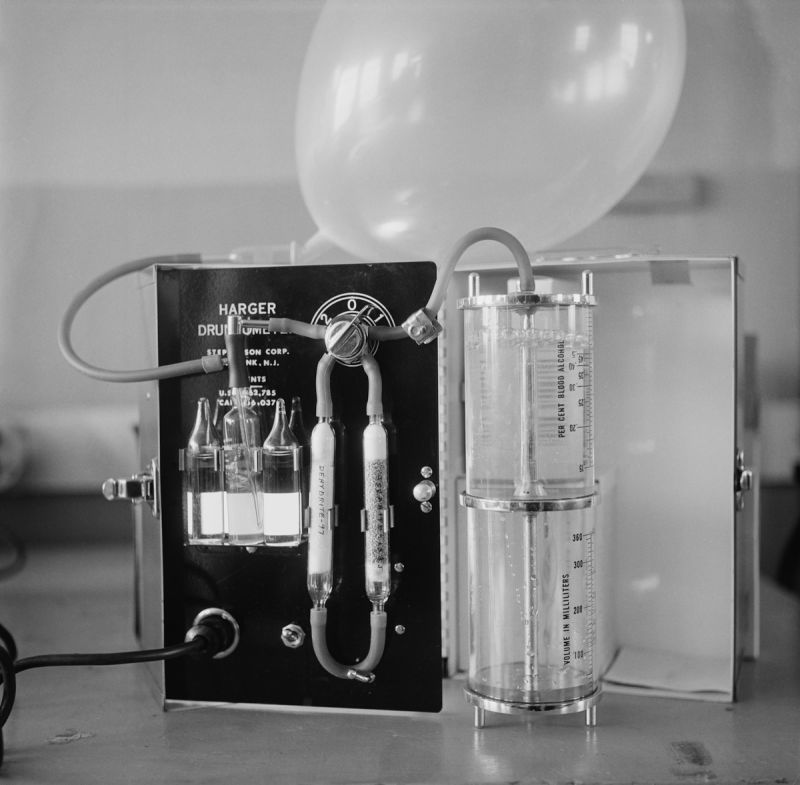
Artifact Spotlight: Early Alcohol Testing with the “Drunkometer"

Historic image of a Drunkometer analyzing the contents of a balloon.
The National Law Enforcement Museum recently acquired a Drunkometer, one of the earliest tools that allowed police officers to conduct roadside breath tests on suspected intoxicated drivers. As more and more Americans began driving in the first half of the twentieth century, drunk-driving accidents increased significantly. Blood and urine samples could be taken to prove blood alcohol levels in impaired drivers after an arrest, but police officers needed a portable way to test drivers in the field and stop drunk-driving accidents before they happened.

Rolla N. Harger, a biochemist from the Indiana University School of Medicine, invented the Drunkometer in the 1930s. This relatively portable kit was essentially a small chemistry set. The police officer would have a driver breathe into a balloon; the breath from the balloon was mixed with chemicals from the kit, causing them to change color. The darker the color the mixture turned, the higher the amount of alcohol in the breath. A simple equation allowed police officers to determine the estimated blood alcohol levels and make an arrest.

The Drunkometer continued to be used into the 1950s, when it began to be replaced by the quicker and more accurate Breathalyzer, invented by Robert Borkenstein. The Woodbridge (NJ) Police Department used this Drunkometer through the early 1970s. Learn more here.

Collection of the National Law Enforcement Museum, 2017.6