Thursday, February 11, 2016

Event Recap: An Evening with Charles Ramsey

It was an evening filled with many stories, enough to fill a 47 year law enforcement career. The program began with Craig Floyd, Chairman and CEO of the National Law Enforcement Officers Memorial Fund, welcoming the audience and introducing the night’s featured guest, Commissioner Charles Ramsey. Floyd outlined the Commissioner’s impressive career, serving first as an officer with the Chicago Police Department who rose through the ranks, then moving up to Chief of Police in Washington DC, and finally retiring as Police Commissioner for the Philadelphia (PA) PD in 2015.

Conversations on Law Enforcement: An Evening with Charles H. Ramsey


Commissioner Ramsey began the program by telling the audience about how he “accidentally became a police officer.” As a young man, he worked in a grocery store where two officers frequently helped close up shop. One asked if he was interested in being a police officer. Despite plans to become a doctor, something about the offer had an appeal, including the fact that the department would pay for his college tuition. Ramsey signed up, became a cadet, and knew that police work was his calling.

Commissioner Ramsey remembered the challenging times police officers faced in Chicago during the 60s and 70s. This included the biggest controversy for the department at the time – integrating police cars. He said, “They called them salt and pepper cars.”
 
The Commissioner also shared how his philosophies on policing have changed over the years. “When asked what my fundamental duty is as a police officer, I used to say, ‘to enforce the law.’ Now I say that it is to protect the constitutional rights of all people. Those are two very different things.”  He also stressed the importance for officers “to strive to make every contact [with the public] as positive as possible,” and that the job really is ultimately about service.

Two of the biggest issues Commissioner Ramsey hopes to see change for police departments moving forward is a greater focus on community policing balanced with data driven systems, and more investment in the mental health of officers around the country.

In closing, Ramsey enthusiastically shared his support of the National Law Enforcement Museum being built, explaining its importance to the country. “[The Museum] captures the good, captures the bad, captures the real version of what police do. Without it, it would be left to Hollywood.”

Finally, Mr. Floyd thanked Commissioner Ramsey for what he has done for the families of officers who have died in the line of duty, acknowledging those in attendance who came to see him for that very reason.

Tuesday, February 9, 2016

Director’s Corner: Museum Construction Begins!

http://www.supporttheline.com

The National Law Enforcement Museum has officially secured the necessary financing to construct and complete our future home on E Street in Washington, DC. We crossed the finish line in late January when we closed on the sale of a number of municipal bonds that will finance the project. The DC Government has issued the building permit and the U.S. Department of the Interior has authorized us to proceed with construction which will commence this month — a major milestone for the museum and our team.

We are excited to be working with Clark Construction, our general contractor, headquartered in neighboring Bethesda, Maryland. Clark is known for their museum experience and has worked on the National Museum of the American Indian, the U.S. Institute of Peace Headquarters & Global Peace Center, and the National Museum of African American History & Culture to name a few.

To keep you updated on the Museum’s progress we will be setting up a webcam to stream the construction process. Check out the next Museum Insider for a link to the camera and in the meantime, please visit www.SupportTheLine.org for more details about the project.

Thursday, January 14, 2016

Celebrating 25 Years Since the Dedication of the National Law Enforcement Officers Memorial


In honor of the 25th anniversary of the National Law Enforcement Officers Memorial, dedicated on October 15, 1991, the Museum Insider will showcase the number 25 in a new feature each month throughout 2016. So stay tuned! To kick things off, enjoy a few bits of law enforcement trivia.


Wednesday, December 9, 2015

Case Closed: TC Williams HS Students Take Part in Traveling Forensics Lab

On Thursday, December 3, 2015, students from TC Williams High School in Alexandria, Va., took part in a Traveling Forensics Lab session, taught by the National Law Enforcement Museum. A teacher at the school set up this forensic activity to have the STEM and Criminal Justice students participate.

Students were able to recreate blood stain patterns made by three different tools in the lab. They were then able to compare the blood stain patterns to those found at a crime scene. Students also used magnetic powder to dust and lift their own fingerprints. They were then able to classify their prints into three categories, loops, arches, or whorls. As part of the experience, they were able to read and verify a suspect’s alibi by looking at their call logs.

This multi-station Traveling Forensics Lab introduces students to forensic science. Students step into the shoes of crime scene investigators to solve a case. The course offers five core workshops that provide the key elements of forensic science and expose students to potential careers in forensics. These workshops were developed to meet the needs of 5th through 12th grade students, but can be tailored for any audience.

If you’re interested in hosting this or other forensic labs for your students, you can contact our educator at 202.737.7860 or education@nleomf.org. You can also look at our Frequently Asked Questions.

Thursday, October 15, 2015

The Great Magician’s Escape


In 1906, the District of Columbia played host to “Handcuff King,” Harry Houdini. The great magician and his wife were visiting Washington, DC for Houdini’s performances at the Chase Theater when Metropolitan Police Chief Major Richard Sylvester invited the escape artist to test the Metropolitan Police’s metal. Sylvester, a leader in American policing, was eager to show off his newest station house built in 1901. The Tenth Precinct’s Lieutenant explained that the station house boasted, “…cells of the most modern and approved pattern. The doors of these cells are steel-barred and have the most intricate combination locks.”

Houdini arrived on January 1, 1906 to the Tenth Precinct to examine the jail cell and locks before the escape. Once he was ready, Houdini was searched, stripped, and placed in cell 3 while his clothes were placed in cell 6. Then, the police officers changed the game. Houdini remembered, “I heard [the police lieutenant] whisper to one of his men to bring him the locks for another cell.” With his pride and reputation on the line, Houdini went on with the trick knowing the stakes had been substantially raised. Houdini later said, “I took a long chance there.”

Officers and Members of No. 10 Precinct
Despite the added difficulty, Houdini completed the amazing escape from the special “invincible” Secret Service handcuffs, two padlocks, and two cell door locks, presenting himself to Police Chief Major Sylvester fully dressed in a mere twenty-six minutes. Chief Major Sylvester later wrote in a letter of testimony, “Mr. Houdini impressed his audience as a gentleman and an artist who does not profess to do the impossible.” Houdini repeated his escape at the Fifth Precinct and the District Jailhouse before departing the Nation’s Capital.

Tuesday, October 13, 2015

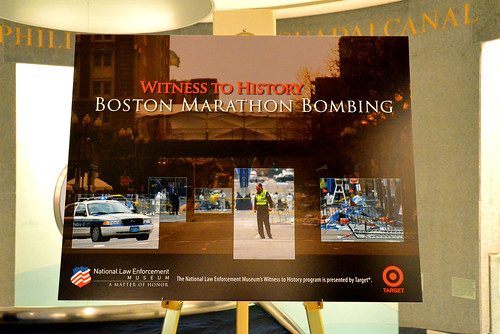
Witness to History: Boston Marathon Bombing

National Law Enforcement Museum’s Panel discussion examined the events of the 2013 Boston Marathon Bombing investigation and its impact on the community.


It was only two and a half years ago on April 15, 2013, that two explosions at the finish line of the Boston Marathon shook the nation and changed the lives of so many. On Wednesday, October 7, 2015 the National Law Enforcement Museum brought together Richard DesLauriers, former Boston FBI Special Agent in Charge and head of the bombing investigation, Sergeant John MacLellan of the Watertown (MA) Police Department who was present during the shootout on the streets of Watertown, U.S. Attorney for the District of Massachusetts Carmen M. Ortiz, the lead prosecutor of bombing suspect Dzokhar Tsarnaev, and moderator Frank Bond, to discuss the events of that fateful day, the processes of finding and prosecuting the perpetrators, and the effects of these events on the community.

It was a crisp morning, and another world-renowned Boston Marathon was underway. No one could suspect what would happen at the finish line that afternoon. There was one blast, and then a second. According to Ms. Ortiz, “News of the explosions just spread like wildfire.”

A joint task force was able to come together quickly thanks to existing relationships among the Boston FBI Field Office, Boston PD, Massachusetts State Police, Watertown PD, and many others. Mr. DesLauriers credited all of the different departments involved in the investigation with its ultimate success. According to DesLauriers, the amount of photographic and video evidence that came in was “overwhelming,” but by focusing on videos of the finish line at Boylston Street, they were able to spot the Tsarnaev brothers. At that point, law enforcement had their primary suspects.

Witness to History: Boston Marathon Bombing

One stumbling block during the investigation was misreporting by the media. At one point, innocent individuals were reported as being under arrest. Rebutting this information cost both Mr. DesLauriers’s and Ms. Ortiz’s precious time. Ms. Ortiz made it clear, “As far as reliance [and] credible evidence, I rely on law enforcement.”

Another tragedy connected to the Boston bombing was the murder of MIT police officer Sean Collier, whose name is engraved on the National Law Enforcement Memorial. Mr. DesLauriers explained that he didn’t initially connect this to the marathon bombings, but after getting a call early on April 19 about a firefight on the streets of Watertown, MA, they were eventually able to connect all the dots. Sgt. MacLellan recalled chaos at the scene of the firefight in Watertown shortly after midnight. The Tsarnaev brothers were shooting at police and throwing bombs. According to Sgt. MacLellan, “This was something you couldn’t train for in our department. It was more like a war zone than a street fight.”

For the rest of the day, area residents were asked to stay in their homes as law enforcement executed a door-to-door search in Watertown. Mr. DesLauriers recalled the 911 call that ended everything the evening of April 19. “A call came in from David Henneberry who, after noticing a weather wrap was loose on his boat, looked inside and saw Dzokhar Tsarnaev alive and sleeping.”

In the end, each panelist was clearly moved by the way Boston and Watertown residents came together and the strength and resilience of the victims and their families. The relationships that were formed as a result of such tragedy was something no one will soon forget.

Thursday, September 17, 2015

One Righteous Man: Samuel Battle and the Shattering of the Color Line in New York

One Righteous Man: Samuel Battle and the Shattering of the Color Line in New York
Purchase Book
Arthur Browne explores the desegregation of the New York Police Department through the extraordinary life of Samuel Battle in One Righteous Man: Samuel Battle and the Shattering of the Color Line in New York.

On June 28, 1911, Samuel Jesse Battle, badge number 782, became the first black policeman in the NYPD. On that day, Police Commissioner Rhinelander Waldo told him, “You will have some difficulties, but I know you will overcome them.” Thus began Battle’s four decadelong career. Along the way Battle pushed through the ranks of the NYPD, navigated the murky waters of Tammany Hall politics, and became a founding citizen of black Harlem. Battle also pushed for equality in all of the city’s civil services, including mentoring Wesley Williams, the first black fire fighter in the New York Fire Department.

Battle’s career was never easy. He faced discrimination and threats even before taking the civil service exam, and Battle’s first day at the Twenty-Eighth Precinct was no different. He was greeted with silence, disdain, and a cot in the precinct’s flag storage loft instead of the dormitory. Years later Battle would recount his feelings to Langston Hughes, his autobiographer for a time, about enduring such abuse.
Sometimes, lying on my cot on the top floor in the silence, I would wonder how it was that many of the patrolmen in my precinct who did not yet speak English well, had no such difficulties in getting on the police force as I, a Negro American, had experienced…My name had been passed over repeatedly. All sorts of discouragements had been placed in my path. And now, after a long wait and a lot of stalling, I had finally been given a trial appointment to their ranks and these men would not speak to me. Native-born and foreign-born whites on the police force all united in looking past me as though I were not a human being. In the loft in the dark, with the Stars and Stripes, I wondered! Why?